
Go-to-Market
How to 10x Your Go-to-Market Content Creation with AI (Properly)

Your teams are already running AI everywhere. Here's how to turn scattered experiments into something the whole company can build on.
Somewhere in your organisation, an AI agent is quietly doing real work. A working student built it. The working student left in March. Nobody knows exactly how it runs, what it costs or what breaks when the model behind it gets switched off.
That's one. Now count the rest. The chatbot pilot in customer service. The content tool marketing pays for by credit card. Two retrieval projects in different departments that have never heard of each other. A stack of proof of concepts (PoCs) that impressed everyone in the demo and then went nowhere.
When we run this inventory with clients, the count usually lands between 20 and 30 initiatives. Two or three are in production. Several duplicate each other. Nobody has the full list.
This is what happens when a technology is useful. It arrives bottom-up, department by department, faster than anyone can coordinate it. Nobody planned the sprawl. It grew.
Here's the uncomfortable part. Every one of those teams is measurably faster with AI. Individual productivity is up almost everywhere. However, company results rarely are.
Economic historians have watched this movie before. When factories swapped steam engines for electric motors in the 1890s, output barely moved for 30 years. The motor was better. The factory hadn't been rebuilt around it. The gains finally arrived when plants were redesigned floor to ceiling around what electricity made possible. (a16z)
Most companies are at the swap-the-motor stage of AI. Faster individuals, same factory.
The gap between individual speed and company results has a specific shape:
Each department feels productive. The company, measured as a company, is standing still.
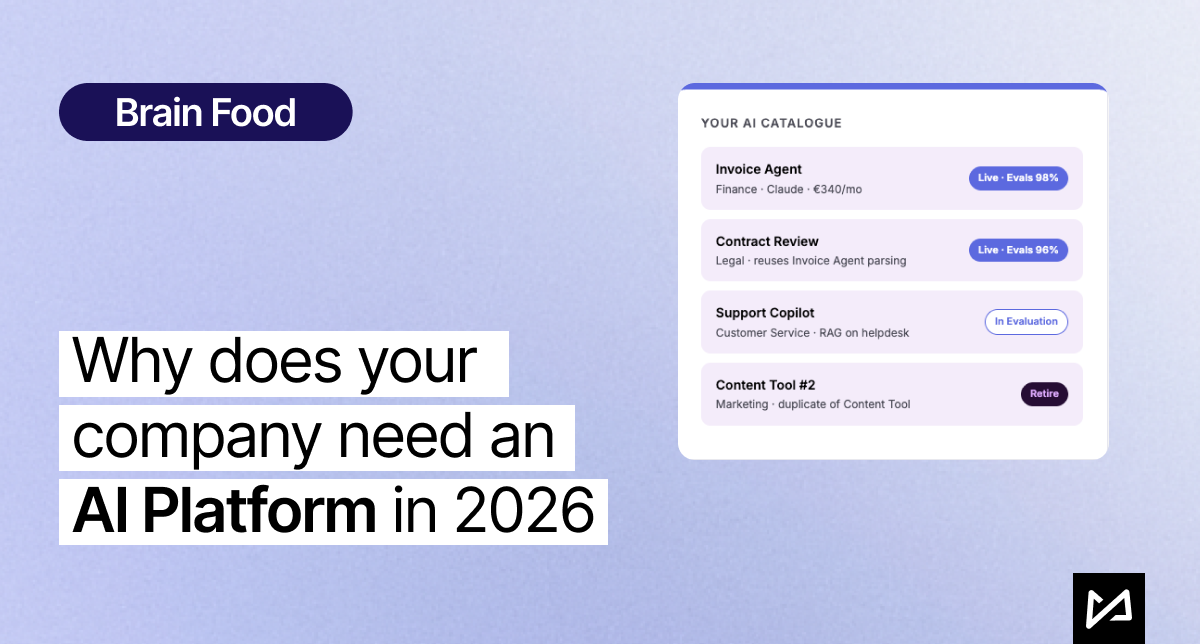
Now picture one place where every AI use case in your organisation is visible. And before any team builds something new, they check what already exists. The document parser sales built becomes a building block for contract review in legal, rather than being rebuilt from zero by a second team who never knew it existed.
Think of it as an internal app store. An AI platform is one place to manage every AI use case in the company. Each use case is an app: built by the team that needs it, shaped around their problem. The apps follow the same compliance rules and run on the same infrastructure, which is where approved models, access control, logging, data connection and cost tracking live.
Teams keep building what they need. The platform handles the infrastructure every app needs and provides the overview.
Here's what that looks like underneath.
Layer 1: the frontend. Where people meet the AI. That's the catalogue itself, where teams browse what already exists before they build anything, plus the surfaces the use cases live on: a chat interface, an assistant inside the CRM, a visual interface of an agent that guides through the project setup process. Access follows your existing identity management, so every app inherits the permissions you've already defined. Management gets its own view here: what's running, who owns it, what it costs, what it delivers.
Layer 2: application layer and infrastructure. The engine room, and the part that decides whether the other two are worth anything. A model gateway, so every team reaches approved models through one door and every request is logged and priced. Retrieval-augmented generation (RAG) over your actual company data. Agent orchestration for multi-step workflows. Evaluation suites that tell you whether outputs are good before your customers do. Observability and cost controls. This layer is where the shared rules live. Build it once and every use case after it starts halfway finished.
Layer 3: the models. This the layer where the AI models sit, where flexibility of switching models between tasks and use cases are enabled. It wires AI models into the systems you already run: CRM, ERP, identity management, document storage. Frontier models for hard reasoning, smaller and cheaper ones for classification and extraction, open-weight models hosted in the EU where data residency or regulation demands it. Models get deprecated and repriced every few months. Because they sit behind the gateway, a swap is one config change in one place.
.png)
One platform orchestrating 30 PoCs. You can see every use case, keep the ones that work, retire the duplicates and stop losing working systems when their builders move on. The document parser sales built gets reused by legal instead of rebuilt from scratch, and when one team improves it, every other team using it benefits too.
Costs become predictable because everything runs through one gateway. Quality becomes consistent because every use case passes the same evaluations before it ships.
And the best part: the next AI idea in your company starts from a platform instead of a blank page. Retrieval, access, evaluation and monitoring already exist, so a new use case doesn't need its own budget line, its own security review or its own vendor contract. It reuses what the last one built.
The factory floor gets redesigned once. Every team after that plugs in, rather than paying to build and maintain its own version of the same machine. Use cases become so accessible and easy that they finally replace the old way of working. And AI adoption increases along the change.
If you suspect your company has more AI initiatives than anyone can list, that's usually the signal. We start with the inventory: what's running, what it costs, what overlaps. It might be an uncomfortable list but a very useful one as the base to build the future infrastructure.
We've been driving digital transformations for many of the leading companies since 2013, and the same pattern keeps showing up: the companies pulling ahead turned their experiments into infrastructure first.
If you'd like to see what your AI estate looks like on one page, talk to us. We are happy to create solutions tailored for your specific needs.
.png)