AI for Digital Products
What is an AI Platform and why your company needs one

You have the message. You know your market better than any outside agency ever will. The gap is everything between knowing it and shipping it as content.
So we built a Go-to-Market (GTM) content engine for companies like yours. It learns your organisation, your products and your customers, then takes the heavy lifting of content production, with your people in the loop on every call that matters. You stay on strategy: what to say, to whom, and why. It handles the how. We run it with several clients now. Here's how it works, and what we've learned building it.
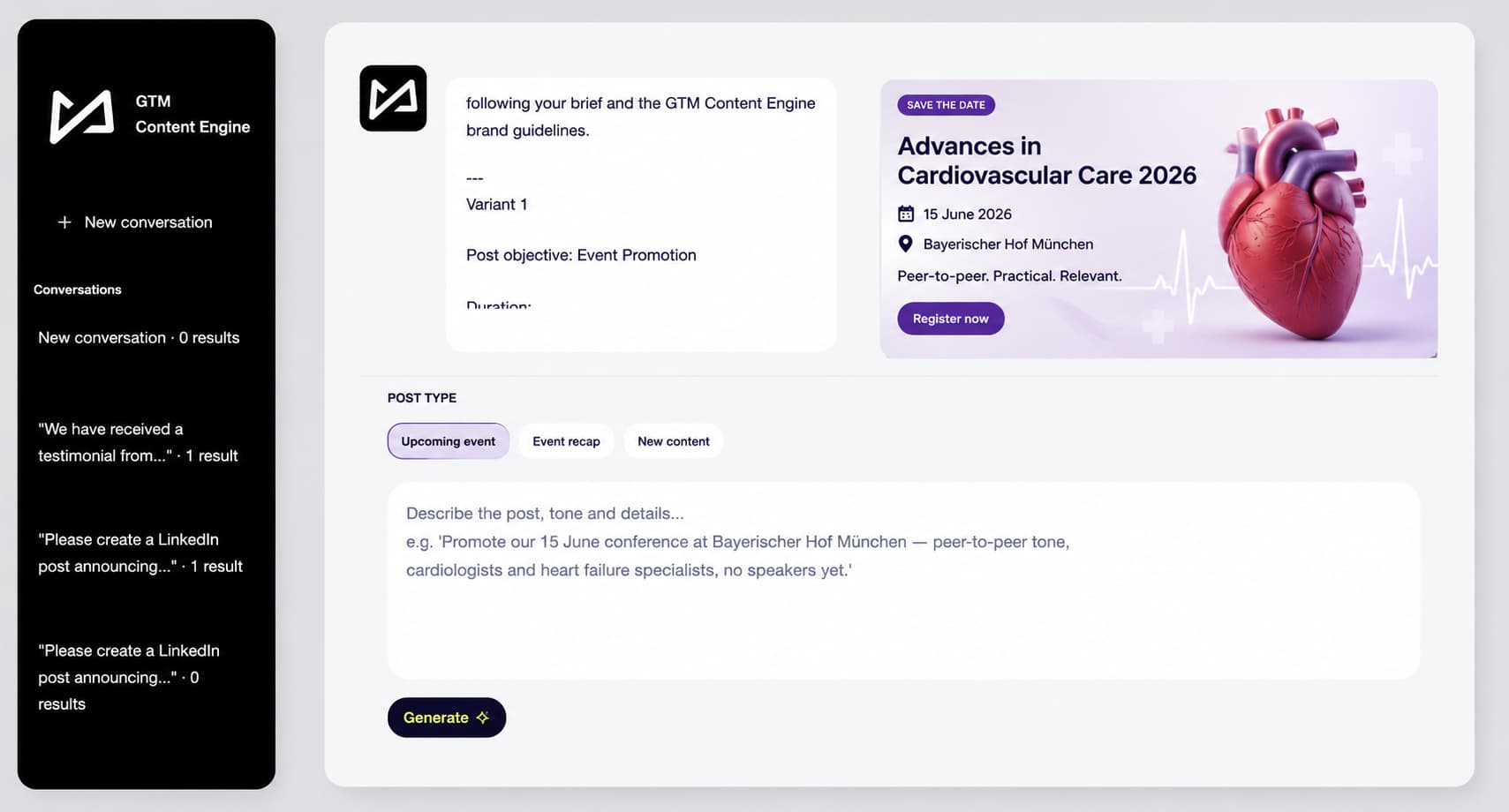
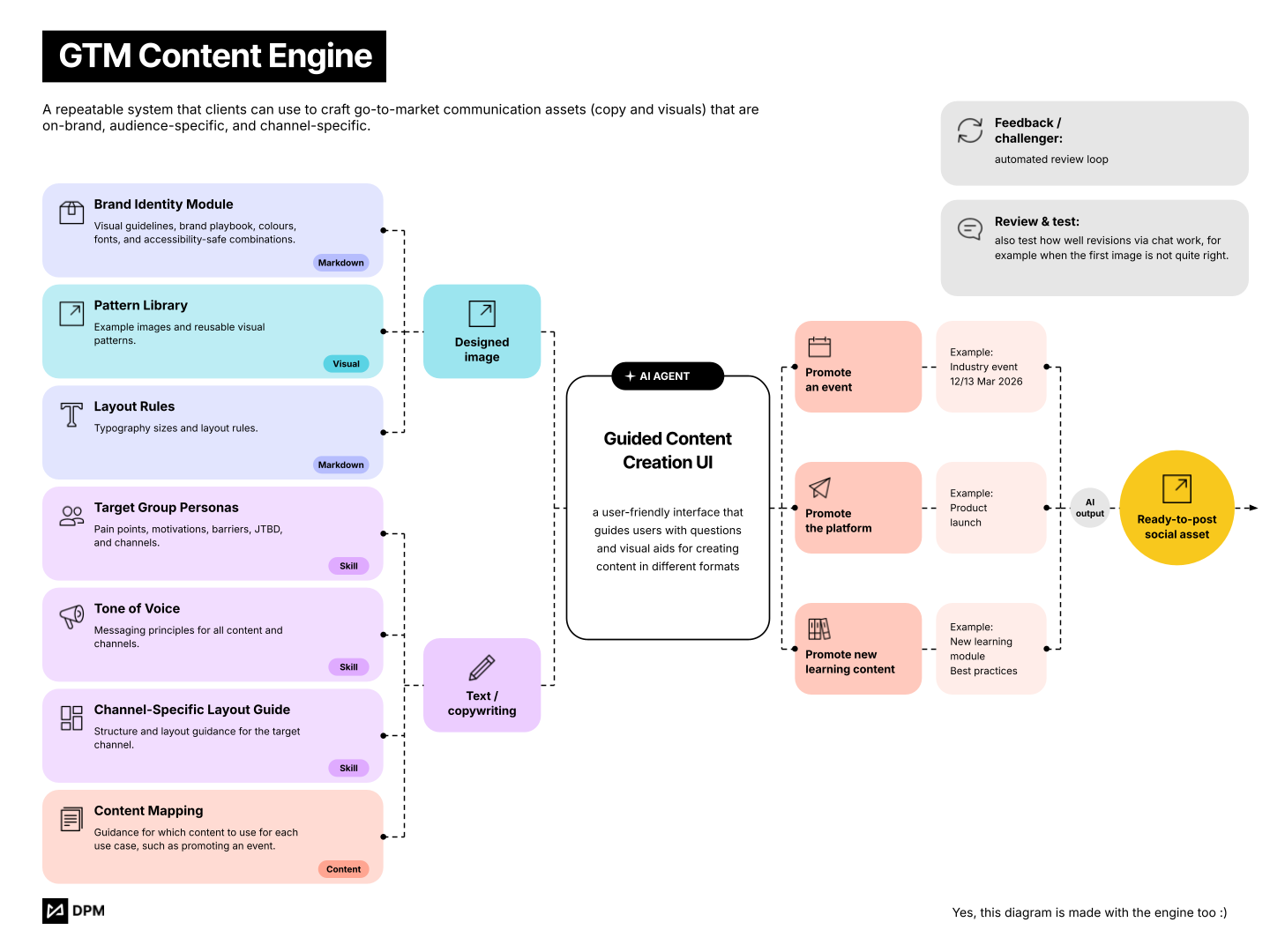
1. Project input. You start with material you already have: customer interviews, sales call notes, your existing site, support tickets, brand guidelines, a Slack thread where someone nailed the pitch. It can arrive raw. The engine reads all of it and writes it back as structured markdown files: persona profiles, tone rules, positioning, a library of reference work. Those files are what every skill downstream reads from.
The material does have to cover the ground. Interviews tell it how your customers talk. Support tickets tell it what they struggle with. Reference posts tell it what good looks like to you. Leave one of those areas out and the drafts go thin in exactly that spot. So the aim is range: several angles on your organisation, your product and your customer, in whatever state they happen to be in.
2. The AI skill library. Instead of one giant prompt, we use a library of small, single-purpose skills, each trained on how good work gets done. One turns raw research into persona blueprints. One maps the customer journey. One drafts a landing page copy in your tone. One generates ad variants. Each does a single job well and carries the standards, so you're editing strong drafts, not starting from a blank page.
3. The GTM asset machine. The skills run in sequence. Research becomes personas. Personas feed the journey map. The map shows which pages and ads to build, and the copy skills draft them. You review, redirect, approve. Then performance data flows back in and the same library rewrites what isn't landing. You're the editor and the strategist. The engine is the production line.
A first launch pass that used to mean three freelancers and a month now takes a couple of days, and you never lose ownership of the message.
Four things that decide whether one of these engines works.
Strong inputs and iteration drive the quality. The engine needs clear inputs to work with: your design, your brand, your existing content. And the genuinely good drafts show up after a few refinement loops, not on the first run. Feed it thin material or stop after one pass, and the output stays flat.
Reusable skills pay off, but they cost to build. Creating and testing a skill takes real time and tokens up front. The return comes later, when that same skill runs on every launch and the whole team can share it. Worth it, as long as you're building for reuse and not for a one-off.
Human review is still hard to wire in. Getting a person into the right point of an automated skill is harder than it sounds. The check tends to land at the end, when redirecting is expensive. We're moving toward agent and sub-agent setups so the human sits where the decision actually happens.
The right model changes by task. There's no single best model, and the answer keeps shifting. Visuals, revisions, cheap high-volume calls, code, structured content: each one wants a different model. Matching the model to the job beats standardising on one and hoping.
Once the engine knows your organisation, the same skill library covers most of the content work on your plate. These are the jobs clients run on it today.
A GTM engine gives your team back serious time. The drafts that used to eat a week show up in an afternoon, and your people spend their hours on what to say rather than how to produce it.
It only pays off when it's built properly. The skills have to be designed around how your business actually runs, fed with your team's knowledge, and trained over time as you learn what your market responds to. That tailoring is what makes it sharper with every launch instead of staying generic.
If that's something you want for your team, we're happy to talk. We'd start with a short discovery session to understand your situation, your products and where the time goes today, then map what a tailored engine would look like for you.
We've packaged the same skill library we use with our clients. You can download our Tone of Voice skill for free and test it on your own copy. Fill out the form and we'll send it over.
It's the first piece of the engine. If it earns its place, we are happy to show you the rest.
.png)