AI for Digital Products
What is an AI Platform and why your company needs one

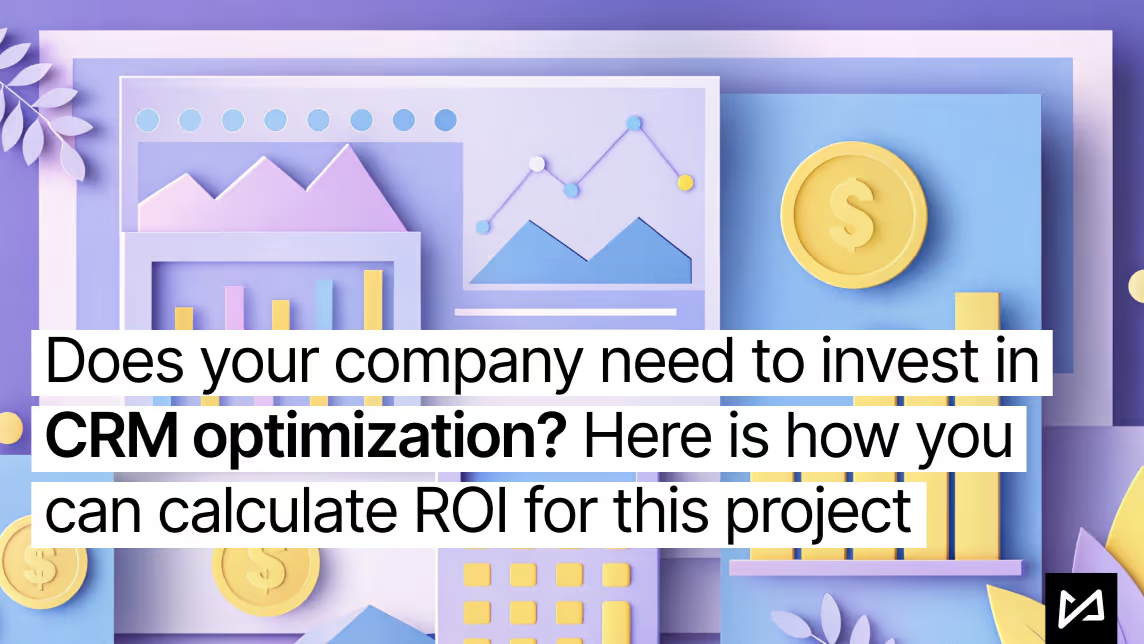
Let’s cut to the chase: your CRM is either a revenue engine or a very expensive digital Rolodex. If it’s not actively saving your team time, boosting your sales, or making your customer interactions smarter, then it’s time to ask: are you using it right and are you willing to change it?
And the next logical question: if you were to change it — would it be worth the investment?
Whether you're still juggling Excel sheets and considering a CRM for the first time, or you’ve already invested thousands in a platform but barely scratch the surface of what it can do — the approach is the same. And it’s not about gut feeling. It’s about ROI.
Let’s start with the basics. CRM ROI (Return on Investment) tells you how much value you’re getting back compared to what you’re putting in. Here’s the formula:
CRM ROI (%) = [(Net Gain – Total Investment) / Total Investment] × 100
Total investment is usually straightforward:
It may sound like a lot — but your net gain can be equally impressive.
This is usually where doubts creep in. We’ll go into the most important ROI indicators in a second, but to put things simply: Your net gain might include commercial improvements like increased revenue from better lead tracking and improved retention, along with internal cost savings from automation or fewer manual tasks.
📊 Spoiler: If the system saves 10 employees 1 hour per week (at €50/hour), that’s €25,000+ back per year — and that alone could already justify a €25,000 CRM project.
While we’re normally fans of CRM revamps, here are some hidden or underestimated costs that can add up quickly (and should not be overlooked):
Let’s start with the usual suspects — but give them some depth:
📩 Want help assessing whether your CRM setup is still delivering enough value? Our team at DPM has helped multiple companies streamline sales and retention through better CRM strategy and tooling. Get in touch.
Don’t just aim to “improve customer relationships” — get specific. Do you want to increase customer lifetime value by 20%? Shorten the average sales cycle by 10 days?
Track high-impact metrics like:
• CLV (Customer Lifetime Value)
• CAC (Customer Acquisition Cost)
• Deal Win Rate
• Sales Cycle Length
Tie each one directly to CRM activity so you can connect usage with real business results.
If only your sales lead knows how to use the CRM, it's not doing its job. Build an onboarding flow that includes:
• Role-based tutorials
• Quick-reference guides
• Regular refresh sessions
Highlight how CRM use saves time and helps your team hit targets — and make that value tangible.
Bad data leads to bad decisions. Set a monthly or quarterly data hygiene checkpoint. Use CRM tools like:
• Automated deduplication
• Mandatory fields
• Validation rules at entry points
The cleaner the data, the more confident your strategy.
Your CRM should sync with your email platform, help desk, ERP — everything. Use built-in integrations or no-code tools to connect workflows. This eliminates manual input and gives you a true 360° view of every customer.
Generic fields and pipelines rarely reflect how your team actually sells. Tailor your CRM with:
• Custom stages and fields
• Tags that reflect your customer segments
• Pipelines that match your deal types
This ensures the CRM fits your team’s needs — not the other way around.
CRM should reduce admin, not create it.
Automate things like:
• Lead assignment
• Follow-up reminders
• Pipeline stage changes
• Monthly reports
Free your team to focus on what matters — building relationships and closing deals.
📩 Curious if your CRM setup is leaving value on the table? Let’s talk!